


By Marta Buczkowska, Registered Dietitian, MyNutriWeb and Martha Redway, Nutrition and Science Communication Manager, Danone UK & Ireland
Plant-based milk alternatives or plant-based drinks are dairy-free beverages made from beans, peas, cereals, nuts, seeds or even potatoes used as an alternative to cow’s milk. Plant milk traditions have existed globally for centuries, from coconut milk around 3000 BC and tiger nut milk in Ancient Egypt to oat milk, developed in the 1990s.1 Consumption in the UK has increased in recent years. UK data shows that around 20-30% of people regularly purchase and consume plant-based milk alternatives 2 and the UK plant-based drink market is the second biggest in Europe.2
Plant-based drinks offer an inclusive alternative to dairy milk, as they can be consumed by people with lactose intolerance, cow’s milk protein allergy, or those choosing not to consume dairy due to religious, ethical, environmental or other reasons.
Plant-based milk alternatives in food-based dietary guidelines and beyond
In recent years, plant-based drinks have moved into the mainstream, not only in retail but also within public nutritional guidelines. Countries such as Australia, Canada, Sweden, Norway and the UK now include plant-based milk alternatives in their protein or dairy section encouraging the citizens to include them as part of their everyday diet.3-6 Their inclusion in the guidelines reflects a combination of factors, including their cultural acceptability, nutritional potential and their role in supporting more sustainable dietary patterns.
Plant-based drinks have also started to make their way into public institutions. In 2025, the US Senate unanimously passed an amendment to the Whole Milk for Healthy Kids Act, giving schools participating in the National School Lunch Program – which serves around 30 million students each year – the option to offer plant-based milk alternatives alongside dairy milk.7 Similarly, an update to Poland’s school food regulations, coming into effect in September 2026, will make low-sugar plant-based drinks fortified with calcium and vitamin B12 available in all schools.8 Plant-based milk alternatives are also increasingly being offered to care home residents and hospital patients. The NHS food standards make the provision of fortified plant-based milk alternatives mandatory to all patients who choose to consume them9 and in Northern Ireland, updated care-home nutrition guidance10 explicitly recognises plant-based diets and includes fortified soya, oat and almond drinks among the options that can form part of residents’ diets. This reflects the growing need for care settings to accommodate plant-based choices while maintaining nutritional adequacy.
In the UK’s Eatwell Guide the government highlights the importance of choosing fortified unsweetened alternatives as the most appropriate choice for the majority of the population.3,11
Why does fortification matter?12
Food fortification describes the process of adding minerals and vitamins to food to improve their nutritional quality. It serves as an important public health strategy helping to avoid nutrient deficiencies, reduce disease risk and support vulnerable populations in meeting their recommended nutrient intake. Mandatory and voluntary fortification are a common strategy practiced in the UK since the beginning of the 20th century. Some of the most-commonly fortified food products include:
- White wheat flour (during the process of milling many important nutrients such as vitamins B, zinc or iron get lost and fortification restores them)
- Plant oil fat spreads with added vitamin D
- Breakfast cereals fortified with vitamins B, iron and vitamin D
- Salt with added iodine (salt fortification with iodine is not common in the UK, however it is currently mandatory in 22 European countries)
- Vitamin D mandatorily added to cow’s milk in countries such as Canada and the US (cow’s milk naturally only contains very small amounts of vitamin D)
Plant-based dairy alternatives are commonly fortified with calcium, vitamin B12, riboflavin and vitamin D. Some products are also fortified with iodine; however, only a relatively small proportion of plant-based drinks currently contains added iodine, making it important to check the label when shopping13. Choosing appropriately fortified alternatives is particularly significant when they replace most or all dairy products in the diet, as highlighted in the recent joint assessment by the Scientific Advisory Committee on Nutrition (SACN) and the Committee on Toxicity (COT).11
- Calcium – often listed as calcium carbonate or tricalcium phosphate. A useful benchmark is at least 120mg/100ml of calcium.
- Iodine – labelled as potassium iodide or potassium iodate, 22.5-45µg/100ml is considered an appropriate level of fortification in the UK.14
- Vitamin B12 – particularly important for people following vegetarian or vegan diets, as UK intakes are typically supported by animal-derived foods.15 Plant-based drinks usually provide 0.38 – 0.9μg vitamin B12 / 100ml.16
- Vitamin B2 – look for products providing at least a ‘source of’ B2 – 0.21mg/100ml.
- Vitamin D – an essential micronutrient that we don’t get enough of in the UK.15 Plant-based milk alternatives usually contain ~0.75μg vitamin D / 100ml.17
Research18 shows that common vitamin B12 and calcium fortificants, such as cyanocobalamin and calcium carbonate, have good bioavailability when consumed in appropriate amounts. However, due to their chemical properties, calcium fortificants in some products can sit at the bottom of the carton – that is why it is so important to shake your milk alternative carton well before drinking!
How to spot whether the drink I am buying is fortified?
Some fortified products clearly indicate the addition of vitamins and minerals on the front of the package, through statements or graphics, making them easy to identify. However, this information is not always immediately visible. As a general rule, it is best to check the ingredient list, where added vitamins and minerals should be listed. They may also be included in the nutritional information table, which can provide another useful way of identifying fortified products.
What about organic products?
It is important to remember that in the UK, law may restrict the fortification of organic products, which means that organic plant-based milk alternatives might lack essential nutrients, including calcium, vitamin B12, riboflavin or vitamin D. This creates a practical counselling point: if patients and consumers are choosing organic plant-based alternatives, healthcare professionals should provide education on the lack of fortification and clearly highlight that non-fortified alternatives cannot directly replace dairy. Guidance on other dietary sources, or in some cases supplementation, of calcium, iodine and vitamin B12 will need to be provided.
Nutritional quality beyond fortification
Fortification is important, but it is not the only consideration. Different plant-based dairy alternatives can offer multiple nutritional characteristics and be appropriate for a wide range of populations with differing nutritional needs. For example, soya drinks can provide a source of complete protein, oat drinks may contribute fibre, and almond drinks may be lower in calories, depending on the product.
Protein
It is important to note that protein content varies considerably between different types of plant-based drinks. While a well-planned whole-food diet should provide a variety of high-quality protein sources, including beans, legumes, nuts, seeds and wholegrains, the protein content of milk alternatives may still be an important consideration for some citizens. Soya drink provides a similar amino acid profile and comparable amount of protein to cow’s milk (around 3 g/100 ml), whereas nut-based, oat and other plant-based drinks typically contain considerably less. Interestingly, a growing number of higher-protein plant-based dairy alternatives are now available, with some soya drinks providing as much as 5 g of protein per 100 ml. These products may be particularly useful for people with higher protein requirements, such as older adults, athletes, or those recovering from illness or injury.
Other nutritional qualities
Unlike dairy milk, plant-based drinks can contribute to fibre intake. Oat drink tends to have the highest fibre content out of all plant-based milk alternatives – ranging from 0.8 to 1.4g per 100ml. This is mainly due to the natural presence of β-glucans soluble fibres19 but can also come from added fibres like chicory root.
Plant-based milk alternatives also contain heart-health-promoting polyunsaturated fatty acids (PUFAs) and monounsaturated fatty acids (MUFAs) and have lower levels of saturated fat in comparison to dairy milk.20 Full fat cow’s milk contains around 4g of fat per 100ml (64% saturated fat), while most plant-based alternatives contain less than 0.5g of saturated fat per glass – with the exception of some coconut milks (i.e. canned coconut milks), some can be comparable to total and saturated fat to dairy and some may be higher.
Considering that currently only 4% (!) of adults in the UK consume the recommended 30g of fibre21 and the majority of the UK population overconsumes saturated fat22, plant-based milk alternatives can play an important role in improving patients’ overall diet quality.
Nutritional composition differs across plant-based drinks – for a full nutritional breakdown, refer to the Unpacking the myths behind plant-based drinks article by the BDA.
What about additives?
Additives and preservatives have become an extremely popular topic within the nutrition space – mainly due to the recent rise in the publicity around ultraprocessed foods and their impact on health. However, as with anything in nutrition in dietetics – nuance and context are crucial, and it is no different in the discussion around plant-based drinks and added ingredients.
Gums, lecithins, stabilisers and oils are sometimes demonised and considered ‘unnecessary additives’, however, these ingredients often serve practical functions – supporting texture, stability, nutrient distribution and usability. For example, stabilisers like gellan gum can help keep added minerals such as calcium evenly distributed throughout a drink, rather than settling at the bottom of the carton.23 This is another useful area for health professionals to be aware of and contextualise. The presence of an unfamiliar ingredient does not automatically make a food nutritionally poor or unsafe. All ingredients used in plant-based dairy alternatives must comply with food law and relevant food safety regulations.24
Plant-based milk alternatives and environmental sustainability
While dairy is often considered a good source of minerals and nutrients, it is worth remembering that in the UK dairy is one of the largest contributors to dietary greenhouse gas emissions (GHGe), second only to red meat.25 Its production is associated with considerable energy use, CO2e emissions (digestive methane constitutes a considerable amount of those emissions), biodiversity loss, water and soil pollution, as well as deforestation.26 The most recognised global Planetary Health Diet framework proposed by the EAT Lancet Commission Report27 suggests including no more than 250g (or 145 kcal) of milk and dairy daily and encourages the consumption of plant-based milk and dairy alternatives to promote health and environmental sustainability, while ensuring appropriate nutritional intake for the majority of the population.
How does plant-based milk alternatives compare?
Research28shows that median per-liter GHGe of soya, oat, almond, spelt, pea, and coconut milks are ~62–78% lower than that of dairy milk. Their production is also associated with using considerably less land, energy and fresh water.
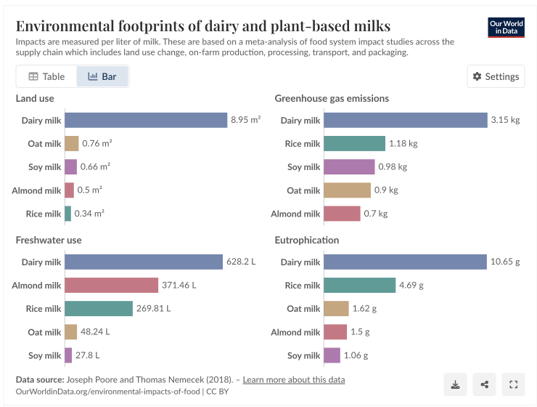
Source: Poore, J. & Nemecek, T. (2018)29
What about soya milk and deforestation?
One common concern about drinking soya milk is that soya production contributes to Amazon deforestation. However, this overlooks how most of the world’s soya is actually used. More than 75% of global and over 95% of Brazilian soya crops are used for animal feed rather than for human consumption. Soya used for human food in Europe and the UK is more likely to come from European supply chains characterised by lower deforestation risk.30
The role of plant-based milk alternatives in the wider dietary patterns
Overall, it is important to put plant-based milk alternatives into the wider context of a healthy dietary pattern. A recent report published by SACN11 acknowledges that cow’s milk is not an essential component of the diet at any age, and the wider scientific consensus highlights that a well-planned plant-based diet is approved as suitable for people across all life stages – as emphasised by the BDA31 and the American Academy of Nutrition and Dietetics.32
Rather than focusing on replacing individual dairy products on a like-for-like basis, healthcare professionals should put an emphasis on achieving a varied, balanced diet rich in whole and minimally processed plant foods, including fruits, vegetables, beans, legumes, wholegrains, nuts and seeds.
Practical tips and considerations to take forward:
Plant-based milk alternatives are now mainstream, and healthcare professionals should be familiar with the key nutritional and practical considerations when discussing these products with patients and clients.
- Which plant-based milk alternatives should I choose?
Choose appropriately fortified, unsweetened options where appropriate. For many people, unsweetened, fortified plant-based milk alternatives will be a suitable choice. However, recommendations should always take into account the individual’s age and life stage, overall dietary pattern, nutritional needs and health goals. - Are all plant-based milk alternatives fortified with the same nutrients?
Check the label. Many plant-based milk alternatives are fortified with nutrients such as calcium, vitamin B12, vitamin D and riboflavin, while some are also fortified with iodine. Fortification levels can vary considerably between products, so patients should be encouraged to check the nutritional composition and ingredient list rather than assuming that all plant-based drinks are nutritionally equivalent. It is also worth advising patients to shake the carton before use, as added nutrients may settle during storage. - Are organic plant-based milk alternatives fortified?
Consider the implications of choosing organic products. Organic plant-based milk alternatives are not commonly fortified with vitamins and minerals. This does not necessarily make them a poor choice, but it is important to consider the individual’s overall diet: Are they consuming a varied diet that provides adequate amounts of key nutrients, or could avoiding fortified products contribute to nutritional gaps? - What is the role of plant-based dairy alternatives in the diet?
When discussing this question, it is important to focus on the whole dietary pattern. From a nutritional perspective, replacing dairy with plant-based drinks should not be a concern for individuals following a balanced diverse diet. The role of healthcare professionals is not simply to recommend one product over another, but to support patients and clients in building a healthy sustainable diet. This includes helping them choose plant-based options that align with their preferences, health status and nutritional needs, while supporting long-term nutritional adequacy. - Are plant-based milk alternatives sustainable?
Be aware of the environmental sustainability of plant-based milk alternatives. Overall, plant-based milk alternatives generally have a lower environmental footprint than dairy milk. Where appropriate, environmental sustainability should be included as a part of a balanced discussion alongside nutritional adequacy, fortification, affordability and personal preferences.
Overall, when consumed as a part of a balanced diet, plant-based drinks can provide a healthy, nutritious and sustainable alternative to dairy milk. Both the BDA and the Eatwell Guide recognise plant-based drinks as a part of a healthy diet suitable for the majority of the population.
References
- Worldplantmilkday.com. [Available from: https://worldplantmilkday.com/heritage/globe/.
- Statista. Plant-based milk and dairy alternatives in the UK – statistics & facts 2025 [Available from: https://www.statista.com/topics/10985/plant-based-milk-and-dairy-alternatives-in-the-uk/?srsltid=AfmBOoq_d8fle41RhLAZeLzjrS0BzjLj5-k5gXoDCIuOs14c9YUN6KSg#topicOverview.
- OHID. The Eatwell Guide 2016 [Available from: https://www.gov.uk/government/publications/the-eatwell-guide.
- European, Commission. Food-Based Dietary Guidelines recommendations for milk and dairy products 2025 [Available from: https://knowledge4policy.ec.europa.eu/health-promotion-knowledge-gateway/food-based-dietary-guidelines-europe-table-7_en.
- Eat For Health. Australian Guide to Healthy Eating [Available from: https://www.eatforhealth.gov.au/guidelines/australian-guide-healthy-eating.
- Government, Of, Canada. Canada’s Dietary Guidelines: Section 1 Foundation for healthy eating [Available from: https://www.canada.ca/en/health-canada/services/food-guide/explore/dietary-guidelines/section-1-foundation-healthy-eating.html.
- PBFA. Policy Win: New Law Expands Student Access to Plant-Based Milks 2026 [Available from: https://www.plantbasedfoods.org/news/senate-passes-legislation-increase-plant-based-milk-in-schools.
- Media GQ. Poland Integrates Plant-Based Meals & Planetary Health Diet Into School Menus 2026 [Available from: https://www.greenqueen.com.hk/poland-plant-based-meals-vegan-school-lunches-health/.
- BDA. The Nutrition and Hydration Digest. 3rd Edition.; 2026.
- PHA. Nutrition guidelines and menu checklist for care homes. 2026.
- SACN C. SACN and COT assessment of the health benefits and risks of consuming plant-based drinks: summary. 2025.
- eufic. What is food fortification? Benefits, examples and how to spot them 2026 [Available from: https://www.eufic.org/en/food-production/article/what-is-food-fortification-benefits-examples-and-how-to-spot-them.
- Nicol K, Nugent AP, Woodside J, Hart KH, Thomas E-L, Wicking JM, et al. Micronutrient fortification of plant-based dairy and seafood alternatives – changes over a five year period. British Journal of Nutrition. 2026:1-7.
- Nicol K, Nugent AP, Woodside JV, Hart KH, Bath SC. The impact of replacing milk with plant-based alternatives on iodine intake: a dietary modelling study. Eur J Nutr. 2024;63(2):599-611.
- OHID. National Diet and Nutrition Survey 2019 to 2023: report 2025 [Available from: https://www.gov.uk/government/statistics/national-diet-and-nutrition-survey-2019-to-2023/national-diet-and-nutrition-survey-2019-to-2023-report#references.
- O’Leary F, Samman S. Vitamin B12 in health and disease. Nutrients. 2010;2(3):299-316.
- Foundation A. Calcium and Vitamin D in a plant-based diet [Available from: https://www.alprofoundation.org/plant-based-eating/calcium-and-vitamin-d.
- Fritz K, Taylor K, Parmar M. Calcium Carbonate. StatPearls. Treasure Island (FL): StatPearls Publishing
- Yadav AK, Ronya N, Rathaur A, Rai DC, Trivedi H, Patel V. Plant-based milk alternatives: processing, nutritional profile, bioactive compounds and health implications. Food Nutrition. 2026;2(1):100061.
- Johnson AJ, Stevenson J, Pettit J, Jasthi B, Byhre T, Harnack L. Assessing the Nutrient Content of Plant-Based Milk Alternative Products Available in the United States. Journal of the Academy of Nutrition and Dietetics. 2025;125(4):515-27.e8.
- Foundation TF. UK still failing to meet basic dietary guidelines 2025 [Available from: https://foodfoundation.org.uk/news/uk-still-failing-meet-basic-dietary-guidelines.
- GOV.UK. National Diet and Nutrition Survey 2019 to 2023: report 2025 [Available from: https://www.gov.uk/government/statistics/national-diet-and-nutrition-survey-2019-to-2023/national-diet-and-nutrition-survey-2019-to-2023-report#:~:text=Fibre,not%20meet%20the%20fibre%20recommendation.
- Suryamiharja A, Gong X, Zhou H. Towards more sustainable, nutritious, and affordable plant-based milk alternatives: A critical review. Sustainable Food Proteins. 2024;2(4):250-67.
- FSA. Approved additives and E numbers 2026 [Available from: https://www.gov.uk/government/publications/approved-additives-and-e-numbers/approved-additives-and-e-numbers.
- Arens U, Linda Convery RD (Chair BPHSG, RD LG, RD SH, RNutr DPM, RD DCP, et al. One Blue Dot. Eating patterns for health and environmental sustainability. BDA; 2020.
- Richter F. Plant-Based Milk Is ‘Low-Emission’ Milk 2025 [Available from: https://www.statista.com/chart/32886/greenhouse-gas-emissions-per-liter-of-dairy-milk-and-plant-based-milk/.
- Rockström J, Thilsted SH, Willett WC, Gordon LJ, Herrero M, Hicks CC, et al. The EAT–<em>Lancet</em> Commission on healthy, sustainable, and just food systems. The Lancet. 2025;406(10512):1625-700.
- Ramsing R, Santo R, Kim BF, Altema-Johnson D, Wooden A, Chang KB, et al. Dairy and Plant-Based Milks: Implications for Nutrition and Planetary Health. Current Environmental Health Reports. 2023;10(3):291-302.
- Poore J, Nemecek T. Reducing food’s environmental impacts through producers and consumers. Science. 2018;360(6392):987-92.
- Ritchie H. Dairy vs. plant-based milk: what are the environmental impacts? 2022 [Available from: https://ourworldindata.org/environmental-impact-milks.
- BDA. Vegetarian, vegan and plant-based diet 2021 [Available from: https://www.bda.uk.com/resource/vegetarian-vegan-plant-based-diet.html.
- Academy of Nutrition and Dietetics. Academy Releases New Position Paper on Vegetarian and Vegan Diets 2025 [Available from: https://www.eatrightpro.org/news-center/research-briefs/new-position-paper-on-vegetarian-and-vegan-diets.
Disclaimer: This blog was supported by an unrestricted educational grant from the healthcare professional support team at the Danone UK. Approval of each partnered activity is carefully assessed for suitability on a case by case basis and is independently peer reviewed Any financial support from grants does not imply any endorsement of an organisation or brand by MyNutriWeb, its organisers, its moderators or any participating healthcare professional, or their association. Funds are reinvested into the creation and promotion of professional development opportunities on MyNutriWeb.


