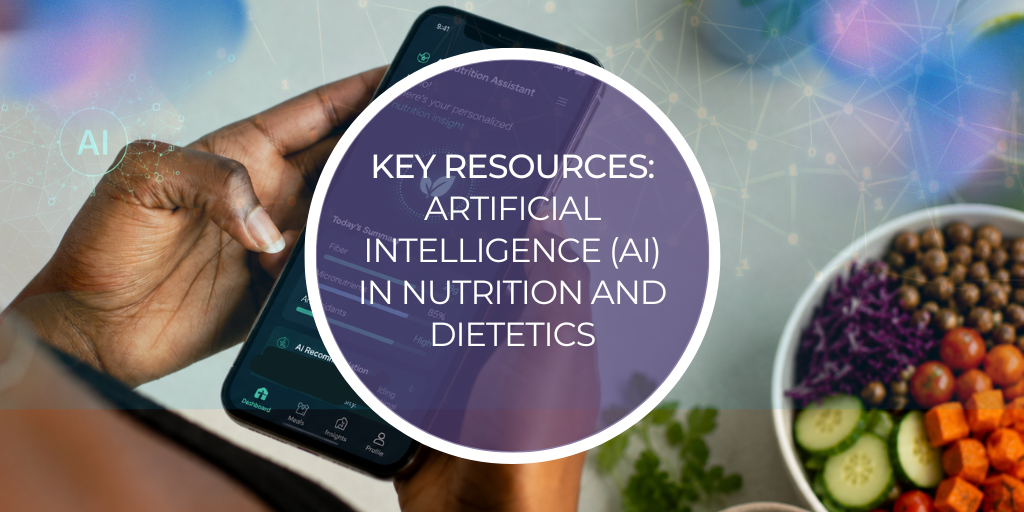
Following on from our symposium Artificial Intelligence (AI) in Nutrition and Dietetics: Opportunities, Challenges, and Future Perspectives we’ve pulled together some of the key resources and references discussed within the symposium. If you missed the live symposium, you can register to watch the recording.
Understanding AI and machine learning
Kirk, D., Kok, E., Tufano, M., Tekinerdogan, B., Feskens, E. J. M., & Camps, G. (2022). Machine Learning in Nutrition Research. Advances in nutrition (Bethesda, Md.), 13(6), 2573–2589. https://doi.org/10.1093/advances/nmac103
Murofushi, K., Thomas, D., Dhakal, S., Park, H., Kleinberg, S., Salvia, M., Jessri, M., Kittrell, H., & Cataldo, A. (2026). Artificial Intelligence and Machine Learning Resource Guide: The Academy of Nutrition and Dietetics and the American Society for Nutrition Joint Taskforce for Artificial Intelligence. The American journal of clinical nutrition, 123(5), 101240. https://doi.org/10.1016/j.ajcnut.2026.101240
O’Hara, C., Kent, G., Leydon, C. L., Walsh, N. M., Gibney, E. R., Skoutas, D., Flynn, A. C., & Timon, C. M. (2026). Language models in nutrition and dietetics: a scoping review. The American journal of clinical nutrition, 123(2), 101127. https://doi.org/10.1016/j.ajcnut.2025.101127
Artificial intelligence (AI) and machine learning: https://www.england.nhs.uk/long-read/artificial-intelligence-ai-and-machine-learning/
Today’s Dietitian Magazine Article | RDs Shaping AI in Nutrition: todaysdietitian.com/rds-shaping-ai-in-the-field-of-nutrition
“AI Powered Nutrition” Facebook Group (for nutrition professionals): facebook.com/groups/350955327768168
A digital vision for the dietetic workforce: https://www.bda.uk.com/resource/a-digital-vision-for-the-dietetic-workforce.html
Byrnes A, Glen K, Matthews-Rensch K, Fry J, MacLaughlin H, Cutmore C, Dux C, Treleaven E, Banks M, Hiatt J, Wu YC, Wan YTJ, Young A. Use and safety of enteral nutrition protocols in acute care: A scoping review of literature and retrospective audit of practice. Nutr Diet. 2024 Feb;81(1):51-62. doi: 10.1111/1747-0080.12819. Epub 2023 Jun 7. PMID: 37287439.
George Katsigiannis, George Panoutsopoulos, Anastasia Perrea, Paraskevi Detopoulou, Comparison of ChatGPT and dietitians in formulating diet plans and recommendations for patients with cardiometabolic diseases, The Journal of Nutrition, 2026, 101667, ISSN 0022-3166, https://doi.org/10.1016/j.tjnut.2026.101667.
Ponzo V, Rosato R, Scigliano MC, Onida M, Cossai S, De Vecchi M, Devecchi A, Goitre I, Favaro E, Merlo FD, Sergi D, Bo S. Comparison of the Accuracy, Completeness, Reproducibility, and Consistency of Different AI Chatbots in Providing Nutritional Advice: An Exploratory Study. J Clin Med. 2024 Dec 20;13(24):7810. doi: 10.3390/jcm13247810. PMID: 39768733; PMCID: PMC11677083.
Communication and misinformation in the age of AI
Ruani, A., Reiss, M.J. & Kalea, A.Z. Development and validation of a tool for detecting misinformation risk in diet, nutrition, and health content (Diet-MisRAT). Sci Rep 16, 9207 (2026). https://doi.org/10.1038/s41598-026-40534-2
Artificial intelligence use in NHS communications: insights, risks and recommendations for safe and effective adoption of AI in NHS communications: https://thenhsalliance.org/resources/ai-use-in-nhs-communications#conclusion-and%20recommendations
Digital literacy: existing educational resource mapping and analysis: https://telblog.hee.nhs.uk/wp-content/uploads/2019/10/6.-Digital-Literacy-Existing-Educational-Resources.pdf
“ChatGPT is not your doctor, dietitian, or therapist”. Why we urgently need safety evaluation standards for generative AI in health, but who will take the lead? Alex Ruani: https://blogs.bmj.com/bmjleader/2025/09/19/chatgpt-is-not-your-doctor-dietitian-or-therapist-why-we-urgently-need-safety-evaluation-standards-for-generative-ai-in-health-but-who-will-take-the-lead/
Ruani MA, Reiss MJ. Susceptibility to COVID-19 Nutrition Misinformation and Eating Behavior Change during Lockdowns: An International Web-Based Survey. Nutrients. 2023 Jan 14;15(2):451. doi: 10.3390/nu15020451. PMID: 36678321; PMCID: PMC9861671.
The impact of AI on wider food environment and food choices
Feeding the algorithm: https://academic.oup.com/fst/article/39/4/18/8382820?login=false
McCarthy DI. Nutritional intelligence in the food system: Combining food, health, data and AI expertise. Nutr Bull. 2025 Mar;50(1):142-150. doi: 10.1111/nbu.12729. Epub 2025 Jan 12. PMID: 39799464; PMCID: PMC11815607.
APPLICATIONS OF AI IN NUTRITION RESEARCH White Paper: https://accesstonutrition.org/app/uploads/2025/10/20251024_APPLICATIONS-OF-AI-IN-NUTRITION-RESEARCH.pdf
Guo, P., Liu, G., Xiang, X., & An, R. (2025). From AI to the Table: A Systematic Review of ChatGPT’s Potential and Performance in Meal Planning and Dietary Recommendations. Dietetics, 4(1), 7. https://doi.org/10.3390/dietetics4010007
Conceptualizing the Digital Food Environment: A Framework: https://www.ssoar.info/ssoar/bitstream/handle/document/105472/ssoar-up-2025-granheim_et_al-Conceptualizing_the_Digital_Food_Environment.pdf?sequence=1&isAllowed=y
Wallis LW, Moore SG. Product promotions in online supermarkets: prevalence of ‘High Fat Sugar Salt’ (HFSS) products and labelling characteristics. Public Health Nutr. 2023 Nov;26(11):2607-2618. doi: 10.1017/S1368980023001787. Epub 2023 Aug 22. PMID: 37606051; PMCID: PMC10641653.
Upskilling in generative AI
How Dietetic Practitioners Can Responsibly Navigate AI: The B.E.A.S.T.I.E. Framework https://www.linkedin.com/pulse/how-dietetic-practitioners-can-responsibly-navigate-drew-zpcbc
OpenAI Academy. Introduction to Prompt Engineering. https://academy.openai.com/public/content
Anthropic. Prompt engineering overview. https://platform.claude.com/docs/en/build-with-claude/prompt-engineering/overview
Stanford AI Courses: youtube.com/@stanfordonline/courses
LinkedIn Article | [BEASTIE for Dietetic Practitioners]: linkedin.com/pulse/how-dietetic-practitioners-can-responsibly-navigate-drew-zpcbc
Other useful resources
British Dietetic Association (BDA) 2027. The BDA and Artificial Intelligence https://www.bda.uk.com/about-us/the-bda-and-ai.html
Partner: SimHealth

SimHealth is a UK-based EdTech company providing AI-powered simulation specifically designed for dietetic education and training. Working with universities and NHS trusts, SimHealth gives dietetic students a safe, controlled environment in which to develop and practise their consultation skills before entering real clinical settings. Students can interact with simulated patients, practise writing in medical notes, engage with the wider MDT – all building the practical skills and confidence that traditional teaching alone cannot consistently provide at scale. By combining the power of AI with the specific demands of dietetic practice, SimHealth is helping to bridge the gap between university learning and clinical reality allowing students to prepare for future placements & practice.
YOU MAY ALSO BE INTERESTED IN:
More than Medication: Optimising Weight-Loss Drug Outcomes in Practice


Hi
Please share the recording link and all other resources.
Hi. The recording and slides and reflective practice form will be sent to you very soon via email. Many thanks! MyNutriWeb
Hi
Please share the link for today’s webinar, AI in Nutrition and Dietetics.
Please also share the slides from the presentations plus a reflective practice form.
Thank you.
Hi. The recording and slides and reflective practice form will be sent to you very soon via email. Many thanks! MyNutriWeb