


By Tiphaine Boulin RNutr, Senior Science Officer at Yakult UK and Ireland and Lucy McLean ANutr, Science Communications Specialist at Yakult UK and Ireland.
The gut microbiome is increasingly recognised for its role beyond digestion, with emerging research exploring links between the gut microbiota, skin health and inflammatory skin conditions. Known as the gut-skin axis, this developing area of research is opening up new conversations about how diet, lifestyle and probiotics might influence skin health.
Growing interest in this field is reflected in a recent scoping review by Yakult Science for Health, in partnership with King’s College London, which identified 516 studies investigating microbiome-targeted interventions and skin health.1 Half of the included studies were published since 2018, highlighting the increasing research activity in this area.
For dietitians, nutritionists and other healthcare professionals, understanding the gut-skin axis is increasingly relevant as patients seek advice on the potential role of nutrition and microbiome-targeted approaches in skin health. But what does the evidence actually tell us?
The skin has its own microbiome
The skin is the body’s largest organ and, like the gut, is home to a diverse community of microorganisms, including bacteria, fungi and viruses, collectively known as the skin microbiome. These microorganisms support skin barrier integrity, protect against pathogens and interact closely with the immune system.
The composition of the skin microbiome varies across the body depending on factors such as moisture, sebum production and environmental conditions. As a result, dry, moist and oily areas of skin each support distinct microbial communities.2
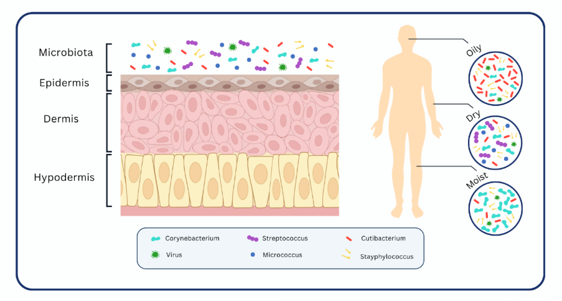
Figure 1: Illustration of the human skin microbiota, showing the different layers of the skin and the variation in microbial communities across oily, dry and moist areas of the body. Source: Yakult Science for Health, The Gut–Skin Axis. Available at: https://hcp.yakult.co.uk/materials/gut-everything-axes/
The Gut-Skin Axis
Increasingly, research suggests that skin health is influenced not only by the microorganisms living on the skin itself, but also by those residing within the gut. This connection is known as the gut–skin axis and describes the bidirectional relationship between the gut microbiota and skin health.
Although the relationship is considered bidirectional, current evidence focuses more on how the gut microbiota influences skin health rather than the reverse.
How do the gut and skin communicate?
Communication between the gut and skin occurs through several pathways, including immune signalling, stress-related hormonal pathways and microbial metabolites.
Immune signalling
The immune system is considered the primary communication route within the gut-skin axis. Around 70-80% of the body’s immune cells reside within the gut associated lymphoid tissue (GALT), where they interact with the gut microbiota.
When the gut microbiota is balanced, it helps regulate immune responses and maintain homeostasis. In contrast, gut dysbiosis (an imbalance in the gut microbiota) may increase intestinal permeability, allowing microbial components such as lipopolysaccharides (LPS) to enter the bloodstream and trigger systemic inflammation. This may contribute to inflammatory processes involved in skin conditions such as acne, atopic dermatitis and psoriasis.3
Stress-related hormonal pathways
Stress may influence the gut-skin axis through activation of the hypothalamic pituitary adrenal (HPA) axis. Increased production of cortisol and proinflammatory cytokines can disrupt gut microbiota composition,4increase intestinal permeability and contribute to systemic inflammation.5
These changes may help explain why stress is often associated with flare-ups of inflammatory skin conditions such as acne, atopic dermatitis, rosacea and psoriasis.6
Microbial metabolites
Microbial metabolites also act as important messengers within the gut-skin axis. Short-chain fatty acids (SCFAs) are produced when gut microbes ferment dietary fibre. These compounds can enter the circulation and exert anti-inflammatory effects throughout the body.
What does the evidence show for inflammatory skin conditions?
An increasing body of evidence links dysbiosis, an imbalance in the gut and/or skin microbiota, with a range of inflammatory skin conditions. Alterations in microbial diversity and composition have been observed in both the gut and skin of individuals with atopic dermatitis, acne and psoriasis, although the mechanisms underlying these associations remain unclear.
Atopic dermatitis (eczema)
- Atopic dermatitis (AD) is one of the most extensively studied conditions within the gut-skin axis literature.
- Individuals with AD have been shown to have lower levels of beneficial gut bacteria, such as Bifidobacterium7>, and higher levels of potentially pro-inflammatory species, like Clostridium and Escherichia coli.8
- Alterations in the skin microbiota are also common, including decreased bacterial diversity and an increased abundance of Staphylococcus aureus, particularly during disease flare-ups.9,10
Acne
- Acne has also been linked to changes in both the gut and skin microbiota.
- Studies have reported reduced gut microbial diversity in individuals with acne, alongside alterations in the abundance of specific bacterial groups.11
- On the skin, acne is associated with a higher abundance of specific pro-inflammatory strains of Cutibacterium acnes and lower overall microbial diversity.12-14
Psoriasis
-
- Psoriasis is a chronic inflammatory skin condition that has also been associated with gut and skin microbiota dysbiosis.
- Research suggests individuals with psoriasis have lower levels of beneficial gut bacteria (e.g. Akkermansia muciniphila, Faecalibacterium prausnitzii) alongside an increased abundance of pro-inflammatory species (e.g. Escherichia coli and Ruminococcus gnavus).15
- Alterations in the skin microbiota have also been reported, including increased levels of Staphylococcus aureus16,17and decreased levels of Cutibacterium acnes.18,19
Can diet influence skin health through the gut?
Diet is one of the most important modifiable factors influencing the gut microbiota and has attracted considerable interest in gut-skin axis research. While no single food or nutrient can prevent or treat inflammatory skin conditions, dietary patterns that support a diverse and resilient gut microbiota may also benefit skin health.
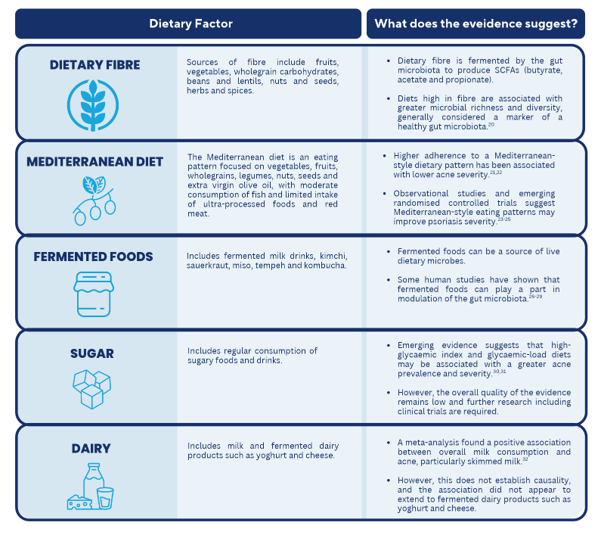
Figure 2: Summary of dietary factors and their potential influence on acne through the gut microbiome. Source: Yakult Science for Health, The Gut–Skin Axis. Available at: https://hcp.yakult.co.uk/materials/gut-everything-axes/
Could probiotics and prebiotics help?
Meta-analyses suggest that probiotics, defined as live microorganisms that confer a health benefit when consumed in adequate amounts,33 may help reduce disease severity in AD.34-36 Certain probiotic strains (e.g. Lactobacillus rhamnosus SP1) have also shown promise in acne.37
Emerging evidence also suggests prebiotic supplements (substrates selectively utilised by host microorganisms that confer a health benefit)38 may support skin health and reduce the risk of AD in high risk infants.39,40However, more research is needed to fully understand the potential role of probiotics and prebiotics in skin health, function and conditions.
Beyond diet: stress and sleep
While diet is often central to discussions around the gut-skin axis, it is one of several lifestyle factors that may influence both gut and skin health. Chronic stress, for example, has been associated with flare-ups of inflammatory skin conditions including acne, AD, rosacea and psoriasis.<6 Stress management approaches may improve symptoms and quality of life for some people with inflammatory skin conditions, when used alongside standard dermatological care.41-44
Sleep is also another important factor. Poor sleep quality and disrupted sleep patterns can alter gut microbial balance45and have been associated with impaired skin barrier function and increased signs of skin ageing.46,47
While further research is needed, these findings highlight the importance of considering lifestyle factors alongside diet when supporting the gut-skin axis.
Key takeaways for healthcare professionals
- The gut-skin axis describes the bidirectional relationship between the gut microbiota and skin health, with immune signalling, stress-related hormonal pathways and microbial metabolites playing important roles in communication.
- Gut and skin microbiota dysbiosis has been associated with inflammatory skin conditions, including atopic dermatitis, acne and psoriasis. However, further research is needed to establish whether these microbial changes contribute to disease development or are a consequence of the conditions.
- Dietary patterns, particularly those rich in fibre and plant foods, may support gut microbiota diversity and potentially influence skin health. However, evidence for direct benefits on inflammatory skin conditions remains limited.
- Probiotics and prebiotics show promise for certain skin conditions, particularly atopic dermatitis, but further research is needed to identify effective strains, interventions and doses.
- Diet and lifestyle factors, including stress management and sleep, should be considered alongside established dermatological care, with advice tailored to individual patient needs.
Research into the gut–skin axis continues to grow, offering new insights into the relationship between the gut microbiota and skin health. While many questions remain, a better understanding of these connections may help inform future dietary and microbiome-targeted interventions to support skin health.
Author Bios:
Tiphaine Boulin RNutr – Tiphaine is a Registered Nutritionist (RNutr) in public health and holds MSc degrees in Human Nutrition and Global Health and Development. In her role as the Senior Science Officer at Yakult Science for Health UK and Ireland she develops evidence-based communications on the gut microbiota, probiotics and health, delivered to healthcare professionals through digital content, educational resources and events. In her career, Tiphaine has led evidence reviews and developed science communication materials across topics including gut health, breast cancer, and women’s health. She has a particular interest in women’s health and the role of nutrition in supporting gut health.
Lucy McLean ANutr – Lucy is a Registered Associated Nutritionist (ANutr) with an MSc in Nutrition from the University of Leeds. She has experience creating evidence-based content and working alongside award-winning nutritionists including Rhiannon Lambert and Clemence Cleave. Lucy is currently the Science Communications Specialist at Yakult Science for Health UK and Ireland. In her role, she translates the science of gut health into accessible, engaging and evidence-based content for healthcare professionals.
References
- Hillier RA, Gibson R, Maruthappu T, et al. Probiotics, Prebiotics, and Synbiotics as Oral Supplements for Skin Health, Function, and Disease Throughout the Life Course: A Scoping Review. Nutr Rev. 2026;84(10):2174-2192. doi:10.1093/nutrit/nuaf205.
- Byrd AL, Belkaid Y, Segre JA. The human skin microbiome. Nat Rev Microbiol. 2018;16(3):143-155. doi:10.1038/nrmicro.2017.157.
- De Pessemier B, Grine L, Debaere M, Maes A, Paetzold B, Callewaert C. Gut-Skin Axis: Current Knowledge of the Interrelationship between Microbial Dysbiosis and Skin Conditions. Microorganisms. 2021;9(2):353. doi:10.3390/microorganisms9020353.
- Madison A, Kiecolt-Glaser JK. Stress, depression, diet, and the gut microbiota: human-bacteria interactions at the core of psychoneuroimmunology and nutrition. Curr Opin Behav Sci. 2019;28:105-110. doi:10.1016/j.cobeha.2019.01.01.
- Di Vincenzo F, Del Gaudio A, Petito V, Lopetuso LR, Scaldaferri F. Gut microbiota, intestinal permeability, and systemic inflammation: a narrative review. Intern Emerg Med. 2024;19(2):275-293. doi:10.1007/s11739-023-03374-w.
- Alexopoulos A, Chrousos GP. Stress-related skin disorders. Rev Endocr Metab Disord. 2016;17(3):295-304. doi:10.1007/s11154-016-9367-y.
- Watanabe S, Narisawa Y, Arase S, et al. Differences in fecal microflora between patients with atopic dermatitis and healthy control subjects. J Allergy Clin Immunol. 2003;111(3):587-591. doi:10.1067/mai.2003.105.
- Penders J, Thijs C, van den Brandt PA, et al. Gut microbiota composition and development of atopic manifestations in infancy: the KOALA Birth Cohort Study. Gut. 2007;56(5):661-667. doi:10.1136/gut.2006.100164.
- Kong HH, Oh J, Deming C, et al. Temporal shifts in the skin microbiome associated with disease flares and treatment in children with atopic dermatitis. Genome Res. 2012;22(5):850-859. doi:10.1101/gr.131029.111.
- Shi B, Bangayan NJ, Curd E, et al. The skin microbiome is different in pediatric versus adult atopic dermatitis. J Allergy Clin Immunol. 2016;138(4):1233-1236. doi:10.1016/j.jaci.2016.04.053.
- Deng, Y., Wang, H., Zhou, J., Mou, Y., Wang, G., & Xiong, X. Patients with Acne Vulgaris Have a Distinct Gut Microbiota in Comparison with Healthy Controls. Acta Dermato-Venereologica. 2018;98(8):783–790. doi:10.2340/00015555-2968.
- Barnard E, Shi B, Kang D, Craft N, Li H. The balance of metagenomic elements shapes the skin microbiome in acne and health. Sci Rep. 2016;6:39491. doi:10.1038/srep39491.
- Fitz-Gibbon S, Tomida S, Chiu BH, et al. Propionibacterium acnes strain populations in the human skin microbiome associated with acne. J Invest Dermatol. 2013;133(9):2152-2160. doi:10.1038/jid.2013.21.
- Lomholt HB, Kilian M. Population genetic analysis of Propionibacterium acnes identifies a subpopulation and epidemic clones associated with acne. PLoS One. 2010;5(8):e12277. doi:10.1371/journal.pone.0012277.
- Thye AY, Bah YR, Law JW, et al. Gut-Skin Axis: Unravelling the Connection between the Gut Microbiome and Psoriasis. Biomedicines. 2022;10(5):1037. doi:10.3390/biomedicines10051037y.
- Tett A, Pasolli E, Farina S, et al. Unexplored diversity and strain-level structure of the skin microbiome associated with psoriasis. NPJ Biofilms Microbiomes. 2017;3:14. doi:10.1038/s41522-017-0022-5.
- Chang, HW., Yan, D., Singh, R. et al. Alteration of the cutaneous microbiome in psoriasis and potential role in Th17 polarization. 2018;6:154. doi:10.1186/s40168-018-0533-1.
- Gao Z, Tseng CH, Strober BE, Pei Z, Blaser MJ. Substantial alterations of the cutaneous bacterial biota in psoriatic lesions. PLoS One. 2008;3(7):e2719. doi:10.1371/journal.pone.0002719.
- Fahlén A, Engstrand L, Baker BS, Powles A, Fry L. Comparison of bacterial microbiota in skin biopsies from normal and psoriatic skin. Arch Dermatol Res. 2012;304(1):15-22. doi:10.1007/s00403-011-1189-x.
- De Filippo C, Cavalieri D, Di Paola M, et al. Impact of diet in shaping gut microbiota revealed by a comparative study in children from Europe and rural Africa. Proc Natl Acad Sci U S A. 2010;107(33):14691-14696. doi:10.1073/pnas.1005963107.
- Taha S, Shakhshir M, Zyoud SH. The mediterranean diet and acne vulgaris: a systematic review and meta-analysis. Nutr Metab (Lond). 2025;22(1):132. doi:10.1186/s12986-025-01033-9.
- Bertolani M, Rodighiero E, Saleri R, et al. The influence of Mediterranean diet in acne pathogenesis and the correlation with insulin-like growth factor-1 serum levels: Implications and results. Dermatol Reports. 2021;14(1):9143. doi:10.4081/dr.2022.9143.
- Barrea L, Balato N, Di Somma C, et al. Nutrition and psoriasis: is there any association between the severity of the disease and adherence to the Mediterranean diet?. J Transl Med. 2015;13:18. doi:10.1186/s12967-014-0372-1.
- Phan C, Touvier M, Kesse-Guyot E, et al. Association Between Mediterranean Anti-inflammatory Dietary Profile and Severity of Psoriasis: Results From the NutriNet-Santé Cohort. JAMA Dermatol. 2018;154(9):1017-1024. doi:10.1001/jamadermatol.2018.2127.
- Perez-Bootello J, Berna-Rico E, Abbad-Jaime de Aragon C, et al. Mediterranean Diet and Patients With Psoriasis: The MEDIPSO Randomized Clinical Trial. JAMA Dermatol. 2025;161(12):1215-1223. doi:10.1001/jamadermatol.2025.3410.
- Wastyk HC, Fragiadakis GK, Perelman D, et al. Gut-microbiota-targeted diets modulate human immune status. Cell. 2021;184(16):4137-4153.e14. doi:10.1016/j.cell.2021.06.019.
- Stiemsma LT, Nakamura RE, Nguyen JG, Michels KB. Does Consumption of Fermented Foods Modify the Human Gut Microbiota?. J Nutr. 2020;150(7):1680-1692. doi:10.1093/jn/nxaa077.
- Leeuwendaal NK, Stanton C, O’Toole PW, Beresford TP. Fermented Foods, Health and the Gut Microbiome. Nutrients. 2022;14(7):1527. doi:10.3390/nu14071527.
- Illikoud N, Mantel M, Rolli-Derkinderen M, Gagnaire V, Jan G. Dairy starters and fermented dairy products modulate gut mucosal immunity. Immunol Lett. 2022;251-252:91-102. doi:10.1016/j.imlet.2022.11.002.
- Penso L, Touvier M, Deschasaux M, et al. Association Between Adult Acne and Dietary Behaviors: Findings From the NutriNet-Santé Prospective Cohort Study. JAMA Dermatol. 2020;156(8):854-862. doi:10.1001/jamadermatol.2020.1602.
- Smith RN, Mann NJ, Braue A, Mäkeläinen H, Varigos GA. A low-glycemic-load diet improves symptoms in acne vulgaris patients: a randomized controlled trial. Am J Clin Nutr. 2007;86(1):107-115. doi:10.1093/ajcn/86.1.107.
- Aghasi M, Golzarand M, Shab-Bidar S, Aminianfar A, Omidian M, Taheri F. Dairy intake and acne development: A meta-analysis of observational studies. Clin Nutr. 2019;38(3):1067-1075. doi:10.1016/j.clnu.2018.04.015.
- Hill C, Guarner F, Reid G, et al. Expert consensus document. The International Scientific Association for Probiotics and Prebiotics consensus statement on the scope and appropriate use of the term probiotic. Nat Rev Gastroenterol Hepatol. 2014;11(8):506-514. doi:10.1038/nrgastro.2014.66.
- Husein-ElAhmed H, Steinhoff M. Effects of probiotic supplementation in adult with atopic dermatitis: a systematic review with meta-analysis. Clin Exp Dermatol. 2023;49(1):46-52. doi:10.1093/ced/llad318.
- Kim SO, Ah YM, Yu YM, Choi KH, Shin WG, Lee JY. Effects of probiotics for the treatment of atopic dermatitis: a meta-analysis of randomized controlled trials. Ann Allergy Asthma Immunol. 2014;113(2):217-226. doi:10.1016/j.anai.2014.05.021.
- Li Y, Zhang B, Guo J, Cao Z, Shen M. The efficacy of probiotics supplementation for the treatment of atopic dermatitis in adults: a systematic review and meta-analysis. J Dermatolog Treat. 2022;33(6):2800-2809. doi:10.1080/09546634.2022.2080170.
- Boby A, Lee G, Natarelli N, Correa L. Using probiotics to treat acne vulgaris: systematic review. Arch Dermatol Res. 2024;316(4):101. doi:10.1007/s00403-024-02836-1.
- Gibson GR, Hutkins R, Sanders ME, et al. Expert consensus document: The International Scientific Association for Probiotics and Prebiotics (ISAPP) consensus statement on the definition and scope of prebiotics. Nat Rev Gastroenterol Hepatol. 2017;14(8):491-502. doi:10.1038/nrgastro.2017.75.
- Arslanoglu S, Moro GE, Schmitt J, Tandoi L, Rizzardi S, Boehm G. Early dietary intervention with a mixture of prebiotic oligosaccharides reduces the incidence of allergic manifestations and infections during the first two years of life. J Nutr. 2008;138(6):1091-1095. doi:10.1093/jn/138.6.1091.
- Moro G, Arslanoglu S, Stahl B, Jelinek J, Wahn U, Boehm G. A mixture of prebiotic oligosaccharides reduces the incidence of atopic dermatitis during the first six months of age. Arch Dis Child. 2006;91(10):814-819. doi:10.1136/adc.2006.098251.
- Chida Y, Steptoe A, Hirakawa N, Sudo N, Kubo C. The effects of psychological intervention on atopic dermatitis. A systematic review and meta-analysis. Int Arch Allergy Immunol. 2007;144(1):1-9. doi:10.1159/000101940.
- Offenbächer M, Seitlinger M, Münch D, Schnopp C, Darsow U, Harfensteller J, Schmid-Grendelmeier P, Ring J, Kohls N. A Pilot Study of a Mindfulness-Based Stress Reduction Programme in Patients Suffering from Atopic Dermatitis. Psych. 2021; 3(4):663-672. doi: 10.3390/psych3040042.
- Kishimoto S, Watanabe N, Yamamoto Y, et al. Efficacy of Integrated Online Mindfulness and Self-compassion Training for Adults With Atopic Dermatitis: A Randomized Clinical Trial. JAMA Dermatol. 2023;159(6):628-636. doi:10.1001/jamadermatol.2023.0975.
- Bartholomew E, Chung M, Yeroushalmi S, Hakimi M, Bhutani T, Liao W. Mindfulness and Meditation for Psoriasis: A Systematic Review. Dermatol Ther (Heidelb). 2022;12(10):2273-2283. doi:10.1007/s13555-022-00802-1.
- Withrow D, Bowers SJ, Depner CM, González A, Reynolds AC, Wright KP Jr. Sleep and Circadian Disruption and the Gut Microbiome-Possible Links to Dysregulated Metabolism. Curr Opin Endocr Metab Res. 2021;17:26-37. doi:10.1016/j.coemr.2020.11.009.
- Oyetakin-White P, Suggs A, Koo B, et al. Does poor sleep quality affect skin ageing?. Clin Exp Dermatol. 2015;40(1):17-22. doi:10.1111/ced.12455.
- Altemus M, Rao B, Dhabhar FS, Ding W, Granstein RD. Stress-induced changes in skin barrier function in healthy women. J Invest Dermatol. 2001;117(2):309-317. doi:10.1046/j.1523-1747.2001.01373.x.


